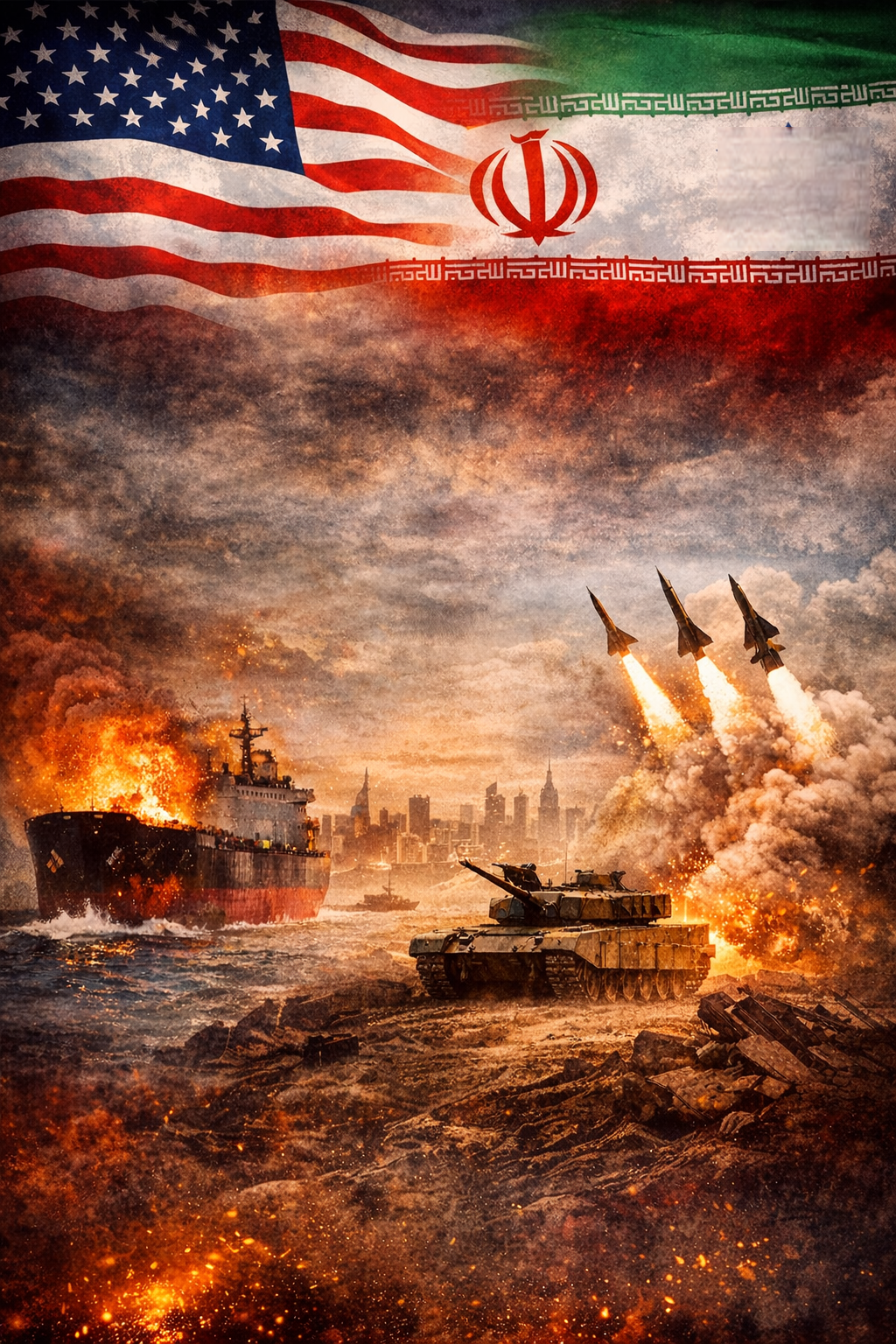
The unfolding conflict often described as a US–Israeli war on Iran has triggered a chain reaction across the global system, deeply affecting major powers such as the United States, China, Russia, and the broader bloc of the European Union. What appears at first as a regional military confrontation has, in reality, evolved into a structural shock impacting trade routes, energy markets, military priorities, and geopolitical alignments.
Impact on Europe
For Europe, the consequences are both immediate and deeply structural. The disruption of the Strait of Hormuz a critical artery for global oil and trade has forced shipping companies to adopt longer and slower routes, significantly raising transportation costs. This logistical strain feeds directly into inflation, as European economies, already sensitive to supply chain volatility, now face higher import prices across a wide range of goods. Energy has become the most pressing concern, with natural gas prices surging dramatically, exposing Europe’s lingering vulnerability despite its earlier attempts to reduce dependency on external energy sources. This crisis is accelerating discussions around renewable energy, not merely as an environmental goal but as a strategic necessity. Militarily, Europe is entering a phase of recalibration, increasing defence budgets while also confronting internal disagreements within NATO, particularly over the implications of aggressive US maritime policies. These divisions highlight a deeper uncertainty about Europe’s strategic autonomy in an increasingly unstable world.
Impact on Russia
Russia, by contrast, finds itself in a more advantageous, though complex, position. While it does face increased shipping costs and logistical challenges, its energy sector is experiencing a significant boom. By redirecting oil exports primarily toward Asian markets, especially China and India, Russia has managed to capitalize on the disruption, with a substantial rise in fossil fuel revenues. This reflects a broader shift in global energy flows, where sanctions and conflicts are reshaping traditional supply chains. Militarily and geopolitically, the conflict offers Russia an indirect benefit by diverting Western attention away from the ongoing war in Ukraine, thereby easing pressure on Moscow. Reports of covert or indirect support to Iran further suggest that Russia is using the conflict as a strategic tool to counter Western influence without engaging in direct confrontation. In this sense, the war acts as a geopolitical distraction that enhances Russia’s relative positioning in the global power hierarchy.
Impact on the United States
The United States, despite being a central actor in the conflict, is experiencing a mixture of strategic assertion and domestic strain. The imposition of a naval blockade has introduced widespread uncertainty into global shipping, increasing costs not only for oil but for a broad spectrum of goods. This demonstrates how military dominance at sea can produce unintended economic consequences, even for the enforcing power itself. On the energy front, the US government has been compelled to release strategic oil reserves to stabilize markets, while domestic refining and exports have increased in an attempt to manage supply shortages. However, rising fuel prices indicate that these measures have not fully offset the broader disruptions. Militarily, the human and financial costs are mounting rapidly, with casualties and injuries highlighting the intensity of the conflict. The enormous expenditure, already reaching tens of billions of dollars within days and projected to escalate significantly, raises critical questions about sustainability and political support. This situation echoes past conflicts where initial military engagement gradually transformed into prolonged economic and strategic burdens.
Impact on China
China’s position reveals a careful balancing act shaped by dependency and opportunism. As a major importer of Iranian oil, China faces direct energy disruptions, forcing it to seek alternatives, particularly from Russia, while also considering the use of its strategic reserves. The interruption of key shipping routes complicates its trade flows, as vessels are delayed, rerouted, or even turned back due to US enforcement measures. Yet, China is not merely reacting defensively; it appears to be leveraging the distraction created by the conflict to advance its interests in contested regions such as the South China Sea. This reflects a broader strategic pattern in which global crises are used to shift regional balances of power. At the same time, allegations regarding the use of Chinese satellite systems by Iran introduce an additional layer of tension between Beijing and Washington, even as China officially denies involvement. This dynamic underscores the fragile and competitive nature of technological and military domains in modern geopolitics.
Conclusion
Taken together, these developments illustrate how a single regional conflict can destabilize multiple layers of the global system. Europe faces economic vulnerability and strategic uncertainty, Russia capitalizes on energy and geopolitical shifts, the United States bears the dual burden of enforcement and cost, and China navigates disruption while quietly expanding its influence. The war, therefore, is not confined to military engagements but extends into economic warfare, energy realignment, and strategic repositioning. It signals a transition toward a more fragmented and competitive international order, where global powers are not merely reacting to events but actively reshaping the landscape in pursuit of long-term advantage.
Source of information: Al-Jazeera