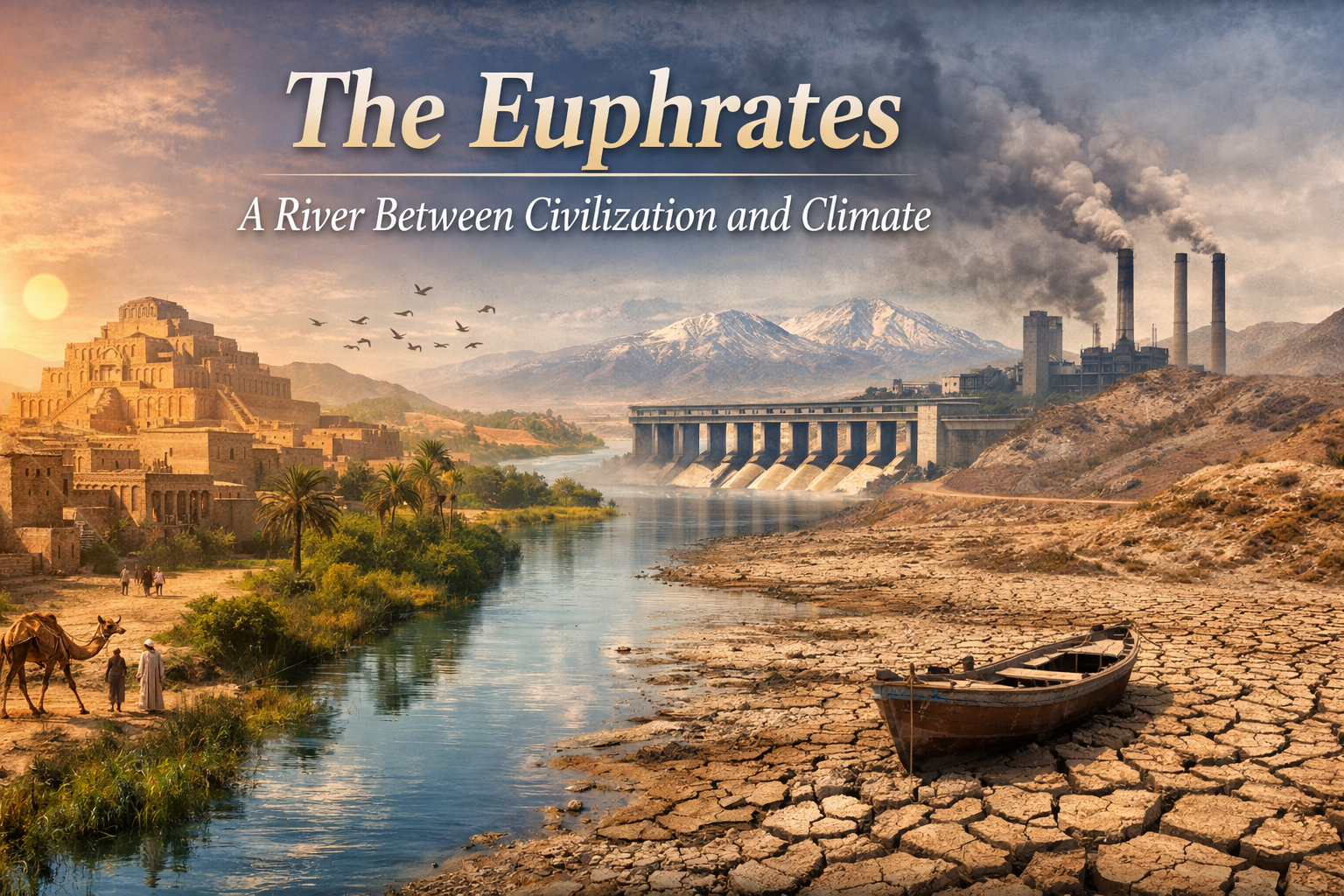
The Euphrates: A River Between Civilization and Climate
When we speak about the great rivers of the world, we often think of the Nile or the Amazon. Yet in the heart of Western Asia flows a river that shaped human history long before many modern nations even existed. The Euphrates River is not merely a geographical feature; it is a living artery that has carried the pulse of civilization for thousands of years. Its waters have nourished empires, defined borders, inspired religious traditions, and today, stand at the center of political and environmental debate.
Introduction and Specifications of the River
The Euphrates River stretches approximately 2,800 kilometers, making it the longest river in Western Asia. It begins in the high mountains of eastern Turkey, where two main tributaries, the Murat and Karasu rivers, merge. From there, it flows southward through Syria and then into Iraq. In southern Iraq, it joins the Tigris River, and together they form the Shatt al-Arab waterway, which empties into the Persian Gulf.
The river basin covers hundreds of thousands of square kilometers. It passes through landscapes that range from snow-covered mountains to dry steppes and vast deserts. Its flow depends largely on rainfall and snowmelt in Turkey, which makes upstream weather patterns crucial for downstream survival. Historically, the river would flood seasonally, spreading nutrient-rich silt across the plains. These floods created fertile soil that supported agriculture in an otherwise arid climate. In a region where annual rainfall can be extremely low, the Euphrates has always been more than water; it has been life itself.
The Cradle of Civilization
Thousands of years ago, the lands between the Euphrates and the Tigris became known as Mesopotamia, meaning “the land between two rivers.” Here, early human societies transformed from small farming villages into complex urban civilizations. Cities rose along the riverbanks, and irrigation canals carried water to distant fields. Writing systems were developed, trade networks expanded, and legal codes were established. The river made stability possible in a region that would otherwise have been dominated by desert winds.
One can imagine ancient farmers watching the river carefully, praying for balanced floods, fearing droughts, and celebrating fertile harvests. The Euphrates did not only shape the land; it shaped culture, belief, and identity. It became a symbol of abundance and continuity.
Political Value in Modern Times
In the modern era, the Euphrates has taken on a new identity: that of a strategic resource. Water today is as powerful as oil, and nations understand that control over water means control over agriculture, electricity, and human survival. Because the river begins in Turkey and flows downstream to Syria and Iraq, it creates a natural imbalance of power. The upstream country has greater influence over how much water reaches its neighbors.
Turkey has constructed large dams and reservoirs to generate hydroelectric power and support irrigation projects. These developments have strengthened its economy but reduced the volume of water flowing into Syria and Iraq. Downstream nations argue that decreased flow threatens their food security and rural livelihoods. Diplomatic negotiations over water sharing have become a permanent feature of regional politics.
In times of conflict, control over dams and water infrastructure has become a military objective. During periods of instability in Syria and Iraq, armed groups fought for control of water facilities because they understood that water means leverage. The Euphrates, once a symbol of unity and shared prosperity, has become intertwined with questions of sovereignty and survival.
International and Geographical Attachment
Geographically, the Euphrates connects three nations in a shared environmental system. What happens in the mountains of Turkey affects farmers in Iraq. A dry winter in Anatolia can mean empty irrigation canals hundreds of kilometers away. This interdependence makes cooperation not just desirable, but necessary.
The river basin illustrates the challenge of managing transboundary water resources in a warming world. It is a reminder that nature does not follow political borders. Rivers flow according to gravity and geography, not diplomacy. This shared dependence creates both tension and opportunity. If managed cooperatively, the Euphrates could serve as a bridge for regional understanding. If mismanaged, it could deepen divisions.
Impact of Its Presence
The presence of the Euphrates has historically transformed desert landscapes into productive farmland. Wheat, barley, dates, and vegetables have thrived because of its irrigation. Millions of people depend on its waters for drinking, farming, and fishing. Entire cities owe their existence to the river’s steady flow.
In southern Iraq, the river contributes to unique marshlands that support biodiversity and traditional communities. These wetlands are home to fish, birds, and a way of life that has survived for centuries. The river’s presence supports not only economic activity but cultural heritage.
Impact of Its Absence
Yet the absence, or even reduction, of the Euphrates tells a different story. In recent years, parts of the river have shrunk dramatically due to drought, dam construction, and climate change. Farmers have reported crop failures. Livestock have suffered. Rural families have migrated to cities in search of work. Marshlands have dried, and ecosystems have weakened.
If the river were to decline further, the consequences could be severe. Food insecurity would increase. Economic pressure would intensify. Social unrest could grow. In a region already facing political challenges, water scarcity adds another layer of vulnerability. The weakening of the Euphrates is not only an environmental issue; it is a humanitarian concern.
Climate Change and the Road Ahead
Climate change now casts a long shadow over the future of the Euphrates. Rising temperatures increase evaporation. Changing rainfall patterns reduce water input. Snowpack in Turkey’s mountains, which feeds the river, has shown signs of decline. Scientists warn that without careful management, river flows could decrease significantly in the coming decades.
However, the future is not entirely bleak. Modern irrigation techniques can reduce water waste. Regional agreements can promote fair distribution. Investment in renewable energy can reduce pressure on hydroelectric dams. International cooperation and scientific research can help countries adapt to changing conditions.
The Euphrates stands at a crossroads. It has survived millennia of natural variation and human ambition. Its waters have witnessed both greatness and tragedy. Today, it demands responsible stewardship. Whether it continues to nourish millions or becomes a symbol of scarcity will depend on political will, environmental awareness, and collective action.
In the end, the Euphrates is more than a river flowing through maps and history books. It is a reminder that geography shapes destiny. Civilizations may rise with rivers, but their survival depends on how wisely they protect them.